Choosing among screen printing presses for small businesses depends on more than color count. Workspace, registration accuracy, production speed, and ease of adjustment all affect how efficiently you can turn blank garments into sellable products.
This roundup compares 10 manual and vacuum-assisted presses for different shop sizes and production goals, helping you match your budget and workflow with the right equipment.
Best 10 Screen Printing Presses for Small Businesses Picks for 2026
Compact Starter Press
VEVOR 1-Color 1-Station Screen Printer

- Compact design suits limited workspaces
- 21.2 x 17.7-inch printing area
- Works on many flat materials
Best For: Home users and small businesses handling occasional single-color jobs
Precision Specialty Press
High-Precision Vacuum Screen Printer

- Vacuum pallet helps prevent substrate movement
- Three-direction micro-registration
- Designed for paper, plastics, films, and boards
Best For: Small shops focused on precise flat-media printing
Adjustable Tabletop Press
INTBUYING 1-Color 1-Station Screen Printer

- 22 x 18-inch printing area
- Adjustable clamp and platen
- Double springs support screen balance
Best For: Table-mounted beginner and small commercial setups
Precision Vacuum Press
HayWHNKN 20x24-Inch Screen Printer

- Vacuum pallet stabilizes lightweight flat materials
- 3D micro-registration supports accurate alignment
- Designed for rigid and non-textile substrates
Best For: Detailed printing on flat, non-textile materials
Small-Shop Production Press
6-Color 6-Station T-Shirt Printer

- Six stations support multi-color T-shirt printing
- Adjustable stand accommodates different working heights
- All-metal construction is durable and cleanable
Best For: Manual multi-color T-shirt production
Ergonomic Micro-Registration Press
EQCOTWEA 6-Color Screen Printer
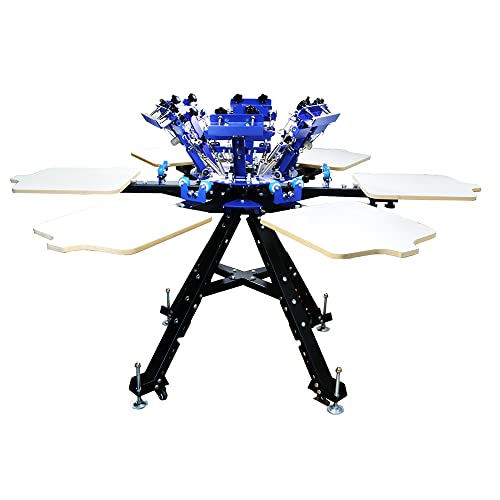
- Fine adjustments improve multi-color registration
- Stand supports seated or standing operation
- Six pallets are designed for stable T-shirt printing
Best For: Heavy-duty, precision-focused apparel production
Compact Micro-Registration Pick

- Four-color, single-station configuration
- Micro-registration for color matching
- Adjustable stand and 22-by-18-inch pallet
Best For: Small shops needing a space-conscious press
Efficiency-Focused Choice

- Two stations for a faster workflow
- Eight micro-registration adjustment knobs
- Includes four screen frames
Best For: Shops seeking more output from a four-color press
Higher-Throughput Floor Model

- Four-station configuration
- Adjustable 28- to 35-inch stand
- Four-inch front-to-back platen movement
Best For: Shops with space for a larger multi-station setup
Compact Starter Press – VEVOR 1-Color 1-Station Screen Printer
For small businesses comparing screen printing presses for small businesses, the VEVOR 1-color, 1-station model offers a compact manual setup with a 21.2 x 17.7-inch printing area. Its steel construction and positioning features make it suitable for occasional production, home use, and small workspaces.
Best For: Small businesses, DIY artists, and home users printing single-color designs on flat materials.
Pros:
- Compact footprint for limited workspaces
- Double-layer positioning design helps reduce print deviation
- Supports fabrics, paper, plastics, wood, glass, ceramics, leather, and other flat materials
- Cold-rolled steel frame with stainless steel components
Cons:
- Limited to one color and one station
- Manual operation requires screen changes for different designs or colors
- Installation is required
This is a practical entry-level choice when space and budget matter more than production speed. The single-color format is best suited to modest orders and straightforward designs.
Precision Specialty Press – High-Precision Vacuum Screen Printer
Businesses needing screen printing presses for small businesses with accurate registration on rigid or flexible flat media may prefer this vacuum model. Its vacuum pallet holds substrates in place, while three-direction micro-adjustment supports fine positioning for detailed work.
Best For: Small production shops printing paper, plastic sheets, films, circuit boards, cards, wood, and metal plates.
Pros:
- 20 x 24-inch vacuum pallet with a 16.5 x 20.7-inch vacuum area
- Three-direction micro-registration adjusts up, down, front, back, left, and right
- Gravity balance plates help balance screens during lifting
- Durable stainless steel pallet and coated metal construction
Cons:
- Heavy 75-pound design may be difficult to relocate
- Not recommended for silk textile printing
- Smaller substrates may require covering unused vacuum holes
This press is more specialized than a basic garment printer. Its vacuum hold-down and registration controls are useful when alignment and repeatability on sheet materials are the main priorities.
Adjustable Tabletop Press – INTBUYING 1-Color 1-Station Screen Printer
The INTBUYING press is a straightforward option for screen printing presses for small businesses, with a 22 x 18-inch print area and adjustable components for different screen and platen positions. Its steel construction is intended for repeated manual use, but it must be secured to a table.
Best For: Small commercial operations and beginners who want an adjustable single-color garment press.
Pros:
- 22 x 18-inch printing area
- Clamp adjusts for screen frames up to 2 inches thick
- Platen adjusts forward and backward by up to 10 cm
- Double springs help balance screens of different weights
Cons:
- Must be fixed to a table with screws
- Screen frame is not included
- Limited to one color and one station
This model offers useful adjustability at a relatively light weight, making it suitable for a dedicated tabletop workspace. Factor in installation and the need to source a compatible screen frame before ordering.
Beginner-Friendly Craft Press – Caydo 1-Color 1-Station Screen Printer
For newcomers exploring screen printing presses for small businesses, the Caydo provides a simple 1-color, 1-station format with a wood structure and alignment-focused base groove. Its compact design supports DIY garment projects without the complexity of a larger production press.
Best For: Beginners and screen printing enthusiasts making single-color t-shirts and creative projects.
Pros:
- Hinge design lets the wood frame lift and hover during printing
- Base groove and centerline help stabilize and align garments
- Accommodates 10 x 14, 8 x 12, and 6 x 10-inch frames
- Lightweight 6.96-pound construction
Cons:
- Limited to one color and one station
- Wood construction may be less suited to heavier production than a steel press
- Designed primarily for smaller DIY and garment projects
The Caydo is a user-oriented choice for learning and low-volume printing. Its frame-size flexibility and garment alignment features are helpful, though businesses expecting frequent larger runs may need a more industrial setup.
Precision Vacuum Press – HayWHNKN 20×24-Inch Screen Printer
For small businesses printing rigid or lightweight flat materials, this vacuum screen printing press offers a precision-focused alternative to apparel equipment. Its 20-by-24-inch pallet, vacuum hold-down, and micro-registration adjustments support accurate work on paper, film, boards, glass, and other compatible surfaces.
Best For: Small businesses producing detailed prints on flat, non-textile materials.
Pros:
- Vacuum pallet helps prevent lightweight materials from shifting or sticking to the screen.
- Three-direction micro-registration and adjustable screen height support accurate alignment.
- Works with transfer paper, PVC, PET, PC, boards, cartons, glass, wood, metal, and plastic.
- Gravity balance plates and adjustable lifting controls accommodate different screen weights.
Cons:
- Not suitable for cloth, ribbons, or other textile products.
- Recommended printing area is limited to 16 by 20 inches.
- Requires a compatible vacuum setup for its hold-down function.
This is a specialized choice among screen printing presses for small businesses. Choose it when substrate versatility and registration accuracy matter more than T-shirt production.
Small-Shop Production Press – 6-Color 6-Station T-Shirt Printer
This six-color, six-station manual press is built for small businesses and individual print shops focused on T-shirts. Its rotating holders, adjustable stand, movable platen, and all-metal construction provide a practical foundation for multi-color apparel production.
Best For: Small apparel businesses producing multi-color T-shirt designs manually.
Pros:
- Six color stations support multi-color T-shirt overprinting.
- 360-degree screen-holder rotation helps with color matching and workflow.
- Height-adjustable stand can be set from 28 to 35 inches.
- All-metal construction is designed for durability and easier cleaning.
Cons:
- Large assembled dimensions require substantial workspace.
- Screen frames must fit within the stated 1.2-inch thickness limit.
- Manual operation requires setup and color registration by the operator.
For businesses centered on T-shirt printing, this press offers useful six-station capacity without moving to automated equipment. Confirm available floor space and screen compatibility before buying.
Ergonomic Micro-Registration Press – EQCOTWEA 6-Color Screen Printer
The EQCOTWEA is a heavy-duty option for small businesses that need repeatable multi-color apparel printing. It combines six rotating 22-by-18-inch pallets with fine micro-adjustments, a height-adjustable stand, and a locking system designed to return screen arms to consistent positions.
Best For: T-shirt shops prioritizing registration control and operator comfort.
Pros:
- Three fine-tuning knobs per screen arm provide multi-directional micro-adjustment.
- Stand adjusts from 23 to 43 inches for sitting or standing operation.
- Positioning and lock wheels help maintain consistent screen placement.
- Six matte melamine pallets provide grip for pallet adhesive and help reduce fabric movement.
Cons:
- At 316 pounds, it is difficult to move once installed.
- Its six 22-by-18-inch pallets require considerable shop space.
- The screen chuck accommodates frames up to 24 inches, limiting larger-frame compatibility.
This is one of the more feature-rich screen printing presses for small businesses seeking manual production with ergonomic flexibility. Its substantial weight favors a permanent, dedicated workspace.
Compact Micro-Registration Pick – 4-Color 1-Station Press
For small businesses seeking screen printing presses for small businesses, this 4-color, 1-station floor model offers a space-conscious setup with micro-registration for color alignment. Its combination design, adjustable stand, and included installation tools make it practical for individual printing shops.
Best For: Small businesses and individual shops prioritizing a compact, single-station workflow.
Pros:
- Supports four-color printing from one station.
- Micro-registration handle helps fine-tune left-to-right screen alignment.
- 360-degree screen-holder rotation and adjustable screen clamps support setup flexibility.
- Includes a 22-by-18-inch melamine pallet and adjustable-height stand.
Cons:
- One station limits simultaneous production.
- Its 55-by-35-by-37-inch footprint still requires dedicated floor space.
- Designed for screen frames up to 1.2 inches thick.
This is a sensible entry-level choice when footprint and straightforward operation matter more than multi-station throughput. The locating detents and adjustable spring tension add useful stability for varied screen weights.
Efficiency-Focused Choice – 4-Color 2-Station Press
This 4-color, 2-station model is one of the more efficiency-oriented screen printing presses for small businesses. Two stations can be positioned at 90 or 180 degrees, while eight adjustable knobs provide fine control for screen alignment.
Best For: Small businesses that want more efficient two-station production without moving beyond a four-color setup.
Pros:
- Two stations support a faster workflow than a single-station press.
- Eight adjustable knobs provide micro-registration adjustments.
- 360-degree screen rotation and locating detents aid positioning.
- Includes four screen frames, a pallet, screen clamp, and user instructions.
Cons:
- Screen frames must be within 1.2 inches thick.
- The supplied details do not specify the machine’s overall dimensions.
- The listed warranty description is six months.
Choose this model if throughput is a priority but you still want a relatively focused four-color platform. Its adjustable spring tension and movable pallet add flexibility when working with screens of different weights and placements.
Higher-Throughput Floor Model – 4-Color 4-Station Press
For shops that need multiple work positions, this 4-color, 4-station floor press provides a larger production platform. It includes micro-registration, 360-degree holder rotation, adjustable stand height, and a pallet that moves four inches front to back.
Best For: Small businesses and individual printing shops with room for a four-station workflow.
Pros:
- Four stations support a more productive multi-position setup.
- Micro-registration helps with precise color matching.
- Stand height adjusts from 28 to 35 inches.
- Locating detents and adjustable spring tension improve screen positioning and balance.
Cons:
- Its approximately 70-by-70-by-43-inch size requires substantial floor space.
- At 229 pounds, it is difficult to reposition frequently.
- Screen frames must be within 1.2 inches thick.
This is the strongest fit of the three for a shop planning around multiple stations rather than maximum compactness. Confirm the available floor area and installation path before choosing this substantially larger press.
How We Picked the Best Screen Printing Presses for Small Businesses
We focused on the features that matter most in a small production environment: station and color capacity, micro-registration controls, pallet size, frame compatibility, footprint, and practical ease of use. The selection includes entry-level one-color presses for learning and short runs, as well as multi-color and multi-station machines for businesses handling larger orders.
We also considered whether a press can support consistent alignment between colors, whether its layout suits a dedicated shop or limited workspace, and how easily an operator can move between jobs. Product specifications should always be confirmed before purchase, especially for frame dimensions, vacuum requirements, and included accessories.
Quick Comparison
| Press type | Best suited to | Main advantage |
|---|---|---|
| 1-color, 1-station | Beginners and low-volume sellers | Lower cost and simpler operation |
| 4-color, 1-station | Small shops producing multicolor designs | More color capability in a compact layout |
| 4-color, 2- or 4-station | Growing apparel businesses | Better workflow and reduced garment handling |
| 6-color, 6-station | Higher-volume production | Multiple colors and stations for faster throughput |
| Vacuum and micro-registration models | Precision-focused printing | Improved holding and alignment control |
Key Buying Factors for Screen Printing Presses for Small Businesses
Color and Station Capacity
Color count determines how many screens can remain mounted for a design, while station count affects workflow. A one-station press can work well for simple jobs, but multiple stations let you load several garments or position screens more efficiently.
Registration and Adjustment
Micro-registration controls are valuable for multicolor artwork because they allow fine alignment corrections. They become increasingly important as designs grow more detailed or production volume increases.
Workspace and Pallet Size
Measure your available floor area, including room for loading garments and moving around the press. Larger 20-by-24-inch vacuum pallets can accommodate substantial prints, but they may require more space and a sturdier setup.
Construction and Maintenance
Look for a stable frame, smooth screen movement, secure pallet mounting, and accessible adjustment points. Manual presses are relatively straightforward, but regular cleaning, lubrication, and accurate leveling still influence print consistency.
Budget and Future Demand
Buy for your likely workload rather than the largest specification alone. A basic press may be the best value for testing a business, while a multi-color, multi-station model can reduce upgrade costs as orders grow.
Who Should Buy Which Screen Printing Presses for Small Businesses?
New sellers, hobbyists, and businesses handling simple one-color designs should start with a one-color, one-station press such as the VEVOR, INTBUYING, or Caydo-style configuration. These models generally offer a simpler learning curve and a smaller commitment.
Businesses producing multicolor graphics in limited space should consider a four-color, one-station press with micro-registration. If workflow speed matters more, a four-color, two- or four-station machine provides a more efficient setup for repeated orders.
Shops focused on precise alignment or larger print areas may prefer a vacuum model with micro-adjustment features. For established apparel businesses with regular multicolor orders, a six-color, six-station press is the strongest fit, provided the workspace, budget, and operator capacity can support it.