Choosing the best food dehydrator for backpacking can help you prepare lighter, more affordable trail meals while controlling ingredients, portions, and flavor. The right model should dry food evenly without taking up unnecessary kitchen space.
We compared these 10 dehydrators by capacity, temperature control, tray design, timer features, portability, and practical usefulness for preparing jerky, fruit, vegetables, herbs, and backpacking meals.
Best 10 Food Dehydrator for Backpacking Picks for 2026
Best Compact Pick

- 95–165°F control in 1°F increments
- 48-hour timer and quiet operation
- Expandable from five to seven trays
Best For: Flexible pre-trip meal and snack preparation
Best Easy-Clean Option
Hamilton Beach Digital Dehydrator

- Five trays provide 4.2 sq. ft. of space
- 48-hour timer with auto shutoff
- Includes mesh and fruit-leather trays
Best For: Simple, hands-off snack preparation
Best for Large Batches
Cosori 6-Tray Stainless Steel Dehydrator

- 6.5 sq. ft. of drying space
- 600W motor with horizontal airflow
- Six stainless steel trays and 48-hour timer
Best For: Preparing large quantities of trip food at home
Best Lightweight Value

- Lightweight 3.9-pound compact design
- 250W system for small batches
- Up to 72 hours with adjustable height trays
Best For: Solo hikers and space-conscious users
Compact Trail Prepper

- 4.2-pound design with five stainless steel trays
- 95–160°F control and up to 48-hour timer
- Adjustable trays and dishwasher-safe components
Best For: Lightweight home prep for backpacking snacks and ingredients
Budget Batch Builder

- Five trays adjust to accommodate items up to 1.5 inches
- 0.5–48-hour timer with automatic shutoff
- Compact footprint and 400W, 360° air circulation
Best For: Flexible batch prep with thicker backpacking ingredients
High-Heat Trail Planner
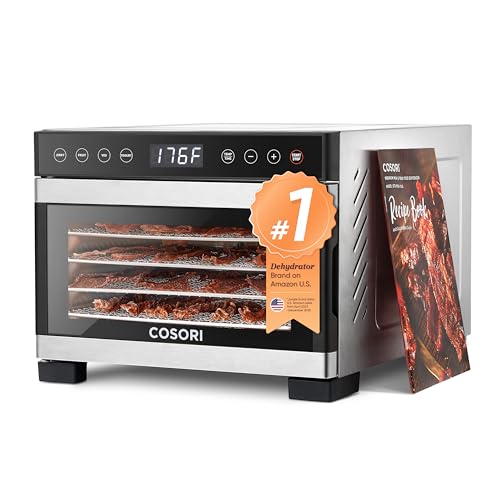
- 95–176°F control in precise 1°F increments
- 3.1 square feet of drying space across five steel trays
- Four presets, 48-hour timer, and included accessories
Best For: Larger, precise batches of trail snacks and meal ingredients
Compact Trail Prep
5-Tray Stainless Steel Dehydrator
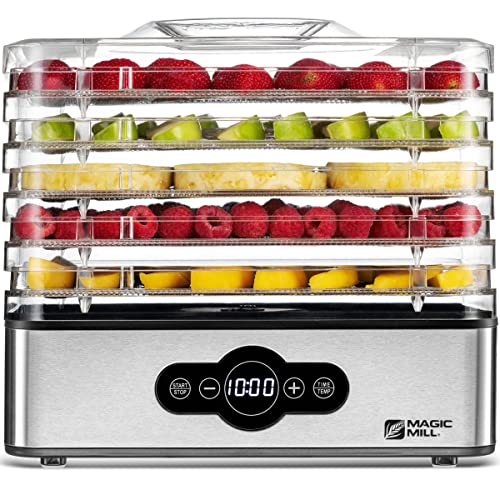
- Five adjustable stainless steel trays
- 95°F–167°F control and 48-hour timer
- Compact 2.75 kg design
Best For: Smaller batches of backpacking snacks and ingredients
High-Capacity Batch Maker

- Ten stainless steel trays for large batches
- Rear fan supports even drying
- Includes mesh and fruit-leather trays
Best For: Preparing food for long trips or groups
Power Prep Station
10-Tray Extra-Large Dehydrator

- Ten extra-large stainless steel trays
- 700-watt power with rear-mounted fan
- 48-hour timer and overheat protection
Best For: Large, frequent backpacking-food batches
Best Compact Pick – Cosori 5-Tray Food Dehydrator
If you want a practical food dehydrator for backpacking meal prep, the Cosori 5-Tray model offers adjustable 95–165°F temperature control, a 48-hour timer, and a relatively light 4.9-pound build. Its expandable tray design also gives you flexibility for larger batches at home.
Best For: Backpackers who want a versatile dehydrator for jerky, fruit, herbs, vegetables, and dog treats before a trip.
Pros:
- Adjusts from 95–165°F in precise 1°F increments.
- Runs for up to 48 hours with 30-minute timer increments.
- Includes five BPA-free trays and can expand to seven.
- Operates at less than 47 dB for quieter overnight use.
Cons:
- Its 12.2-inch round footprint may be less convenient for narrow storage spaces.
- It weighs more than the smallest compact dehydrators.
The Cosori is a strong all-around choice when temperature precision and expandable capacity matter more than absolute minimum size. The 4.9-pound weight makes it more manageable for storage and transport than larger models, though it is still primarily suited to preparing backpacking food at home.
Best Easy-Clean Option – Hamilton Beach Digital Dehydrator
For a straightforward food dehydrator for backpacking snacks, the Hamilton Beach model combines five BPA-free trays with digital timing, automatic shutoff, and 4.2 square feet of drying space. Its included mesh screen and fruit-leather sheet add useful preparation options.
Best For: Backpackers who value simple controls, hands-off drying, and convenient cleanup.
Pros:
- Offers adjustable 100–160°F temperature control.
- 48-hour digital timer shuts the unit off automatically.
- Includes a mesh screen for herbs and a fruit-leather tray.
- Trays and lid are dishwasher-safe when using the recommended wash settings.
Cons:
- At 8 pounds, it is heavier than the Cosori compact model.
- Its temperature range does not extend as low or high as some listed alternatives.
- The one-year warranty is shorter than the two-year warranties on the Cosori models.
The Hamilton Beach makes batch preparation uncomplicated, especially if you want to load the trays, set the timer, and let the automatic shutoff handle the finish. Its larger weight is less appealing for transport, but it remains useful for making backpacking ingredients at home.
Best for Large Batches – Cosori 6-Tray Stainless Steel Dehydrator
If you are preparing food for an extended trip, this large Cosori can serve as a high-capacity food dehydrator for backpacking supplies. Six stainless steel trays provide 6.5 square feet of drying space, while the 600-watt motor and horizontal airflow are designed for consistent drying without manual tray rotation.
Best For: Large households or serious trip planners making substantial quantities of backpacking food at once.
Pros:
- Provides 6.5 square feet of drying space across six stainless steel trays.
- Uses a 600-watt motor and rear-mounted fan for faster, even drying.
- Offers precise 95–165°F control and a timer up to 48 hours.
- Includes dishwasher-safe trays, a mesh screen, and a fruit-roll sheet.
Cons:
- At 18.1 pounds, it is substantially heavier than the other options.
- Its 17.8-inch depth requires considerable storage space.
- Its large capacity may be excessive for occasional small batches.
This model is best viewed as a home-base production tool rather than something to carry into the backcountry. Its generous capacity and stainless steel construction make it well suited to preparing multiple days of meals and snacks, provided you have adequate counter and storage space.
Best Lightweight Value – Small 5-Tray Food Dehydrator
When space and energy use are priorities, this small food dehydrator is a convenient food dehydrator for backpacking preparation. The 3.9-pound unit has five height-adjustable BPA-free trays, a 250-watt heating system, and up to 72 hours of operation for small batches of fruit, jerky, herbs, vegetables, or pet treats.
Best For: Solo backpackers, apartment dwellers, and occasional users who need a compact, lightweight prep machine.
Pros:
- Weighs just 3.9 pounds and measures 7.28 by 11.81 by 7.87 inches.
- Uses a lower-power 250-watt heating system for small batches.
- Provides five height-adjustable, transparent BPA-free trays.
- Supports operation for up to 72 hours with 95–158°F control.
Cons:
- Its 95–158°F range is narrower than the Cosori models’ ranges.
- The small design is less suitable for large quantities of trip food.
- It uses knob controls rather than a digital control panel.
This is the easiest option to justify when you want a compact appliance for modest batches and limited storage. Its low weight and 250-watt system are appealing for occasional backpacking prep, while the smaller capacity means larger groups may need multiple runs.
Compact Trail Prepper – OSTBA 5-Tray Dehydrator
If you want a practical food dehydrator for backpacking meal prep, the OSTBA offers five stainless steel trays, adjustable temperature control, and a relatively light 4.2-pound design. Its 400W system and 360° airflow are suited to drying fruit, vegetables, herbs, and jerky before a trip.
Best For: Backpackers preparing lightweight snacks and ingredients at home, especially those who value a compact footprint and easy cleanup.
Pros:
- Five rust-resistant stainless steel trays with adjustable spacing from 0.55 to 1.02 inches.
- Temperature range of 95–160°F and a 1–48-hour timer support varied foods.
- Removable dishwasher-safe trays, non-slip feet, and cord storage simplify use.
- At 4.2 pounds, it is lighter than the other listed options.
Cons:
- The maximum temperature is lower than the Cosori’s 176°F setting.
- Its five trays provide less stated drying area than the Cosori’s 3.1 square feet.
The OSTBA is a straightforward, lightweight option for dehydrating backpacking ingredients in regular batches. Its adjustable trays and dishwasher-safe parts add flexibility, while the 160°F ceiling may matter if you prioritize higher-temperature jerky preparation.
Budget Batch Builder – Rosewill 5-Tray Dehydrator
The Rosewill is a compact food dehydrator for backpacking preparation, combining five adjustable trays with 400W heating and 360° hot-air circulation. It can handle fruit, vegetables, herbs, meat, jerky, and dog treats, making it useful for preparing varied trail foods in one session.
Best For: Users who want flexible tray spacing and a long timer for preparing several types of backpacking food at once.
Pros:
- Five BPA-free, food-grade trays can be raised for ingredients up to 1.5 inches thick.
- Adjustable timer runs from 0.5 to 48 hours, with automatic shutoff.
- 360° circulation, non-slip feet, quiet operation, and dishwasher-compatible trays support convenient use.
- Compact dimensions of 8.3 by 11.4 by 8.2 inches suit limited counter space.
Cons:
- The supplied details list conflicting temperature information: the feature description says 95–158°F, while specifications state 95–195°F.
- At 14.7 pounds, it is substantially heavier than the OSTBA.
Rosewill’s strongest advantage is its unusually generous adjustable tray height, which helps with thicker slices and larger pieces. However, verify the actual temperature range before buying, particularly if your backpacking recipes depend on a specific drying temperature.
High-Heat Trail Planner – Cosori 5-Tray Dehydrator
For a food dehydrator for backpacking meal preparation, the Cosori stands out with five stainless steel trays, 3.1 square feet of drying space, and temperature control up to 176°F. Its horizontal airflow, presets, and included fruit-roll sheet make it versatile for preparing trail snacks and ingredients.
Best For: Backpackers who want higher temperature control, dedicated presets, and more clearly stated drying space for larger preparation sessions.
Pros:
- Adjusts from 95–176°F in precise 1°F increments.
- Five stainless steel trays provide 3.1 square feet of drying space.
- Includes jerky, fruit, vegetable, and yogurt presets plus a 48-hour timer.
- Includes a mesh screen, fruit-roll sheet, recipe book, and two-year manufacturer warranty.
Cons:
- At 10.8 pounds, it is heavier than the OSTBA.
- Its 13.9-inch depth and 8.9-inch height require more storage space than the smaller listed models.
The Cosori is the most feature-rich choice of the three for backpacking prep, particularly when precise temperatures and included accessories matter. Its larger drying area is useful for batches, but the heavier body and larger footprint make it less convenient to store or transport.
Compact Trail Prep – 5-Tray Stainless Steel Dehydrator
If you need a food dehydrator for backpacking meal prep, the Magic Mill MFD-5000 offers a relatively compact five-tray setup with simple digital controls. Its 240-watt design handles fruit, vegetables, herbs, jerky, and other foods, while the adjustable trays accommodate thicker ingredients.
Best For: Backpackers who want a compact dehydrator for preparing smaller batches of trail snacks and ingredients.
Pros:
- Five adjustable stainless steel trays can be raised for thicker foods.
- Digital temperature control from 95°F to 167°F and a timer up to 48 hours.
- Detachable trays are washable and dishwasher safe.
- Compact dimensions and a 2.75 kg listed weight make it easier to store than larger models.
Cons:
- The five-tray capacity is smaller than the other models in this roundup.
- Its 240-watt output may be less suited to large-batch preparation.
- The supplied details list the temperature range as 95°F–167°F in the features but also show 158°F in the specifications.
This is the most space-conscious option of the three, making it a practical choice when you value a smaller footprint over maximum batch capacity. It is especially suitable for occasional trail-food preparation at home.
High-Capacity Batch Maker – 10-Tray Pro Dehydrator
For backpackers preparing food for longer trips or groups, this Magic Mill Pro food dehydrator provides ten stainless steel trays and rear-mounted airflow circulation. The digital timer, automatic shutoff, and included mesh and fruit-leather accessories make it versatile for jerky, herbs, fruit, and compact trail foods.
Best For: High-volume meal prep when you want multiple tray types and even drying without manually rotating shelves.
Pros:
- Ten stainless steel trays provide substantially more batch capacity than the five-tray model.
- Rear-mounted fan and airflow circulation are designed for even drying.
- Temperature range of 95°F–176°F, digital timer, automatic shutoff, and keep-warm function.
- Includes mesh trays and a fruit leather sheet for smaller foods and fruit roll-ups.
Cons:
- At 14 pounds and 15.5 inches deep, it is better suited to home prep than carrying on the trail.
- The 600-watt design may use more electricity than the compact 240-watt option.
- The supplied dimensions indicate a larger countertop footprint.
This model is a strong fit for preparing several days of backpacking food at once. Its capacity and included accessories add flexibility, though the size and weight mean it should stay at home rather than travel in a pack.
Power Prep Station – 10-Tray Extra-Large Dehydrator
This 700-watt Magic Mill Premium model is built for substantial backpacking food prep, with ten extra-large stainless steel trays and a rear-mounted fan. Its 48-hour timer, adjustable 95°F–167°F temperature range, and keep-warm function give you control over longer dehydration sessions for jerky, fruit, vegetables, and herbs.
Best For: Serious home-based trail-food preparation where maximum tray size, power, and batch capacity matter most.
Pros:
- Ten extra-large trays support high-volume dehydration in one batch.
- Rear-mounted fan and precision airflow are designed to dry trays evenly.
- 700 watts of power, a 48-hour timer, automatic shutoff, and overheat protection.
- Dishwasher-safe trays and liners simplify cleanup.
Cons:
- At 20.5 pounds, it is the heaviest option and not pack-portable.
- The 18-inch depth and 13-inch width require considerable counter space.
- Its higher wattage may be unnecessary for small batches.
If you routinely dehydrate large quantities of food before backpacking trips, this is the most capable option in the lineup. The extra-large trays and 700-watt output favor productivity, while the substantial size makes it a dedicated home-prep appliance.
How We Picked the Best Food Dehydrator for Backpacking
We focused on features that matter when preparing food for hiking and camping: adjustable temperature control, usable drying space, tray material, timer functionality, cleaning convenience, and overall size. Models with stainless-steel trays may appeal to buyers who prioritize durability and odor resistance, while BPA-free plastic trays can keep weight and cost lower.
Because backpacking preparation often involves batch cooking, we also considered how much food each dehydrator can handle at once. However, a larger capacity is not automatically better if the appliance is difficult to store or excessive for occasional use.
Quick Comparison
| Feature | What to look for | Why it matters |
|---|---|---|
| Capacity | Five trays for small batches; six to 10 for larger meal prep | Determines how much food you can dry per cycle |
| Temperature range | Adjustable settings up to about 160–167°F | Supports different foods, from herbs to meat |
| Timer | Digital timer, ideally up to 24–48 hours | Reduces monitoring during long drying cycles |
| Tray material | Stainless steel or BPA-free plastic | Balances durability, weight, visibility, and cleanup |
| Power | Roughly 350–700 watts | Influences drying performance and energy use |
Key Buying Factors for a Food Dehydrator for Backpacking
Capacity and Storage
Choose capacity based on your meal-prep routine. A compact five-tray unit is usually sufficient for solo trips or occasional batches. Six- to 10-tray models are more practical when preparing food for a group or dehydrating several ingredients at once, but they require more counter and storage space.
Temperature and Drying Control
Adjustable temperature settings are essential because fruit, vegetables, herbs, and meat do not dry at the same rate. A timer is equally useful, particularly for overnight cycles. For jerky and other meat products, follow tested food-safety guidance rather than relying only on the appliance’s maximum temperature.
Portability and Cleanup
Most electric dehydrators are intended for home preparation, not use on the trail. Consider the machine’s footprint, tray nesting, cord storage, and weight before buying. Removable trays and dishwasher-safe components can simplify cleanup after sticky fruit or seasoned jerky.
Who Should Buy Which Food Dehydrator for Backpacking?
Choose a compact five-tray model if you have limited storage, prepare food for one or two people, or want an affordable entry point. Choose stainless-steel trays if durability, odor resistance, and long-term use are priorities. Choose a six- or 10-tray dehydrator if you routinely prepare complete backpacking menus, bulk fruit, or large batches of jerky. Choose a model with a long digital timer if convenience and unattended drying are especially important.
Before buying, confirm the listed dimensions, temperature range, timer limits, included trays, and cleaning instructions. The best Food Dehydrator for Backpacking is the one whose capacity and controls match your preparation volume without becoming harder to store or use than necessary.