Freshly milled flour can improve flavor and give home bakers more control over grain selection, texture, and batch size. The right electric grain mill makes that process faster and more consistent than manual grinding.
These 10 models range from compact countertop mills to high-powered commercial-style grinders. Use the guide below to compare capacity, motor power, grind flexibility, cleanup, and everyday practicality before you buy.
Best 10 Electric Grain Mills Picks for 2026
Stone-Milled Favorite

- 450-watt motor with corundum milling stones
- Adjustable texture control knob
- Thermal protection with automatic shutoff
Best For: Home cooks seeking adjustable stone milling
High-Speed Multi-Ingredient Grinder

- 2800-watt motor with 28,000 rpm speed
- 750g capacity and 304 stainless steel body
- Handles grains, spices, herbs, and coffee
Best For: Small-batch dry ingredient grinding
Commercial Throughput Pick

- 2200 watts with approximately 154 lb/h output
- Adjustable grinding thickness
- Large stand-mounted design for dry grains
Best For: High-volume dry grain processing
Compact Bread-Flour Specialist

- 1200-watt motor for hard grains
- 8-cup hopper and 12-cup canister
- Nesting design with cyclone air filtration
Best For: Frequent bakers making fresh bread flour
Wet-and-Dry Workhorse

- Dry and wet grinding discs included
- Adjustable thickness for varied results
- Heavy-duty cast-iron construction
Best For: Wet soybean and rice processing plus high-volume dry milling
Large-Batch Dry Mill
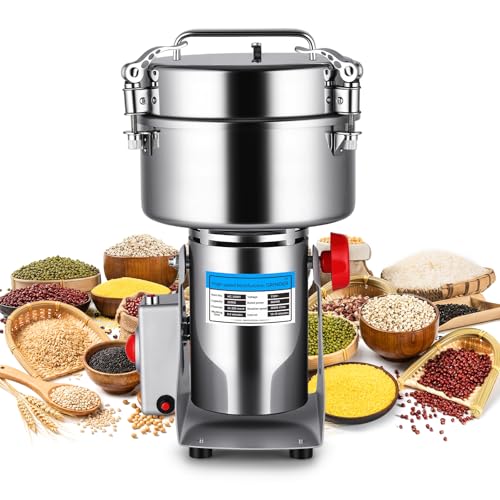
- 3000g capacity for sizable batches
- 30- to 300-mesh powder adjustment
- Overload protection and stainless-steel body
Best For: Dry grains, spices, and coffee in home or small-café settings
Farm-Scale Adjustability
3000W Heavy-Duty Grain Grinder

- Rated for up to 200 pounds per hour
- Adjustable from coarse meal to fine powder
- Galvanized cast-iron housing
Best For: Small farms, feed preparation, and high-volume dry grain milling
High-Capacity Pick
750g Stainless Steel Grain Grinder
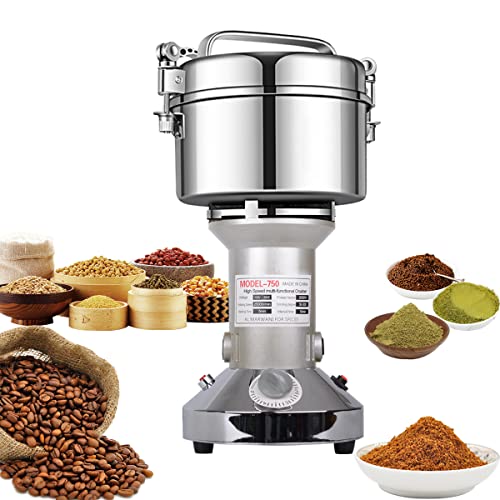
- 750g capacity and 25,000 RPM operation
- Triple blades for fine dry grinding
- Overload protection and stainless steel body
Best For: Home users processing dry grains, spices, herbs, and coffee
Versatile Home Mill

- 800g capacity for larger dry batches
- Includes sieve for regrinding coarse particles
- Timer, lid stop, and overload protection
Best For: Home and light commercial dry grinding
Timed Grinding Pick
VEVOR 1.8-lb Electric Grain Mill

- 1.8-lb capacity and 28,000 RPM motor
- 5-, 15-, and 30-second timer settings
- 270-degree swing design and triple blades
Best For: Timed batch grinding of dry grains, spices, and coffee
Stone-Milled Favorite – NutriMill Harvest
The NutriMill Harvest is a practical choice for shoppers comparing electric grain mills for regular home use. Its 450-watt motor, corundum milling stones, and adjustable texture control are aimed at producing flour with a texture suited to your preferences.
Best For: Home cooks who want adjustable stone milling in a compact, USA-assembled design.
Pros:
- 450-watt heavy-duty motor handles grain milling.
- Near-diamond-hard corundum stones are designed for durable grinding.
- Patented texture control knob lets you adjust the grind.
- Thermal protection includes automatic shutoff, and the unit is CSA tested and listed.
Cons:
- At 20.4 pounds, it is not especially lightweight for frequent moving.
- Its stated capacity and output are not provided in the supplied details.
With a 7-by-7-inch footprint and 13-inch height, the Harvest offers a relatively manageable counter profile while retaining stone-milling features. It is a solid fit when texture adjustment and home-oriented construction matter more than maximum commercial throughput.
High-Speed Multi-Ingredient Grinder – 750g Stainless Steel Mill
This 750g model stands out among electric grain mills for its high-speed motor and broad ingredient range. It is designed for dry grains, spices, herbs, and coffee, with a timer-based approach to controlling grinding fineness.
Best For: Users who need a stainless-steel grinder for small batches of grains and other dry ingredients.
Pros:
- Food-grade 304 stainless steel construction is sturdy and durable.
- 2800-watt pure copper motor reaches up to 28,000 rpm.
- Works with grains, spices, herbs, and coffee beans.
- Timer settings help control fineness from 70 to 300 mesh.
Cons:
- Continuous grinding should not exceed five minutes, followed by a cooling period.
- The motor should not be rinsed directly with water, so cleaning requires wiping.
- Its 8.3-by-8.3-by-14-inch size may be more than needed for occasional flour grinding.
The 750g capacity and three-blade design make this a versatile option beyond flour production. Buyers should plan around the specified short grinding cycles and dry-material-only use for reliable operation.
Commercial Throughput Pick – 2200W Electric Grain Grinder
For shoppers comparing electric grain mills by capacity and speed, this 2200-watt model is built around high-volume dry grinding. Its stand-mounted design, stainless steel funnel, and adjustable output thickness suit demanding grain-processing tasks.
Best For: Users who need high-throughput grinding of dry grains such as wheat, rice, corn, sorghum, and soybeans.
Pros:
- 2200-watt motor is rated for approximately 154 pounds per hour.
- Adjustable output thickness supports finer or thicker results.
- Durable construction combines stainless steel, iron, galvanized iron, and precision cast steel.
- Cooling holes help dissipate heat during operation.
Cons:
- At about 43.1 pounds and 28 inches high, it is a substantial stationary appliance.
- It is intended for dry materials only; water or wet ingredients may cause engine failure.
- The shipment is divided into two parcels that may arrive separately.
This grinder is better suited to a dedicated work area than a typical kitchen counter. Its output rating and adjustable thickness make it compelling for larger batches, provided you can accommodate the size and follow the dry-grinding requirement.
Compact Bread-Flour Specialist – NutriMill Impact Compact
The NutriMill Impact Compact is a focused option for shoppers seeking electric grain mills for fresh wheat and bread flour. Its 1200-watt motor, impact milling heads, and storage-friendly nesting design balance batch capacity with a compact footprint.
Best For: Frequent bread bakers who want fine-textured flour and convenient storage.
Pros:
- 1200-watt motor is designed to mill hard grains such as wheat.
- Impact milling heads target consistent, fine-textured bread flour.
- 8-cup hopper and 12-cup flour canister support larger batches.
- Patented cyclone air filtration helps maintain airflow during milling.
Cons:
- The supplied details do not state an adjustable texture-control feature.
- Color options and detailed dimensions are not provided in the supplied information.
- Its impact-milling design is specifically oriented toward fine bread flour rather than a broad range of grinding tasks.
The included hopper, canister, lid, and air filter create a practical setup for repeat baking sessions, while the nesting parts simplify storage. It is a strong match for bread-focused users who value batch handling without a bulky storage footprint.
Wet-and-Dry Workhorse – VEVOR 3000W Grain Mill
For shoppers comparing electric grain mills, this VEVOR model stands out for its combination of high power, adjustable thickness, and wet-and-dry grinding capability. Its cast-iron construction and included funnel suit frequent milling of grains, spices, and other ingredients.
Best For: Home food makers, small food businesses, and users who want to process both dry grains and soaked soybeans or rice.
Pros:
- Supports both dry grinding and wet grinding with separate milling discs.
- 3000W motor is designed for continuous, high-capacity grinding.
- Adjustable thickness helps produce coarse or fine results.
- Stainless-steel funnel and cast-iron body are built for heavy use.
Cons:
- Its industrial size and approximately 27.56-inch height require substantial counter or floor space.
- The product is heavier-duty than many casual household users may need.
This is a versatile choice when wet processing matters as much as dry flour or spice grinding. Choose it if you have room for an industrial-style machine and want adjustable results across a broad range of ingredients.
Large-Batch Dry Mill – Jivoxia 3000G Grain Grinder
This electric grain mill is designed for large dry batches, with a 3000-gram chamber, 3600W motor, and 270-degree swing motion. It suits users who want finely powdered grains, spices, or coffee beans while prioritizing overload protection and straightforward wipe-down care.
Best For: Home bakers, small cafés, and dry-ingredient users who need a relatively large single-batch capacity.
Pros:
- 3000g capacity can process substantial dry batches.
- Adjustable output from 30- to 300-mesh powder supports fine grinding.
- Triple-layer stainless-steel blades and 270-degree swing motion are intended to improve consistency.
- Overload protection automatically shuts the motor off when necessary.
Cons:
- Limited to completely dry ingredients; wet or oily materials should not be used.
- Requires cooling breaks after up to three minutes of operation.
- The chamber should be cleaned without rinsing it with water.
Consider this model if batch size and fine powder production are more important than wet-grinding versatility. Its operating limits require patience, but the safety cutoff and stainless-steel body add practical reassurance for dry milling.
Farm-Scale Adjustability – 3000W Heavy-Duty Grain Grinder
Among electric grain mills, this 3000W grinder is aimed at users who need fast processing and flexible grind control. Its notes cite up to 200 pounds of grain per hour, adjustable settings, and a galvanized cast-iron housing for farm, feed, flour, and spice applications.
Best For: Small livestock farms, home flour milling, brewing, and users preparing dry grain for feed or storage.
Pros:
- 3000W pure-copper motor is rated for high-throughput grain processing.
- Adjustable settings accommodate coarse feed and finer flour or powder.
- Handles dry corn, wheat, soybeans, rice, barley, and some herbs.
- Corrosion-resistant galvanized cast-iron housing is designed for durability.
Cons:
- At 47 pounds and nearly 31 inches tall, it is bulky and not especially portable.
- The industrial design may be excessive for occasional kitchen use.
- The supplied notes do not specify a wet-grinding function.
This model makes the most sense when throughput and grind adjustment are central requirements. Its large footprint and heavy weight favor a dedicated milling area, farm workspace, or small food-production setup rather than casual countertop use.
High-Capacity Pick – 750g Stainless Steel Grain Grinder
If you need electric grain mills for dry grains, spices, coffee, or herbs, this 750g stainless steel grinder offers high-speed pulverizing in a compact countertop format. Its 2,000W motor and triple-blade design are built for fine results, but the short operating cycles require planned pauses.
Best For: Home kitchens and small-scale users grinding dry grains, cereals, spices, herbs, and coffee in batches up to 750g.
Pros:
- Large 750g capacity with a high-speed 25,000 RPM motor.
- Triple-blade design supports grinding from approximately 50 to 300 mesh.
- Stainless steel construction and overload protection add durability and safety.
Cons:
- Only suitable for dry materials; wet, oily, or moist ingredients should not be used.
- Requires a 5–10 minute rest after every three minutes of operation.
- The motor housing should be wiped clean rather than rinsed with water.
This model is a practical choice when capacity and fast dry grinding matter more than continuous operation. Follow the fill limit and rest periods to get the most reliable performance.
Versatile Home Mill – 800g Triple-Blade Dry Grinder
Among electric grain mills, this 800g swing-type grinder stands out for its broad dry-ingredient range and included sieve. It is designed for home kitchens and light commercial use, with a timer, lid safety stop, and overload protection for more controlled batch grinding.
Best For: Home cooks, cafés, restaurants, and food shops that need to grind dry grains, coffee, pepper, spices, and similar ingredients.
Pros:
- 800g maximum capacity and triple-blade design for efficient grinding.
- Supports grains including wheat, oats, rye, peas, corn, and soybeans.
- Includes a sieve for separating coarse particles and regrinding them.
- Timer, automatic lid stop, and overload protection improve control and safety.
Cons:
- Not intended for wet, fresh, oily, or sticky materials.
- Requires a 5–10 minute interval between grinding periods.
- Cleaning is limited to wiping or brushing; direct water rinsing can damage the motor.
The included sieve makes this a useful option when you want to refine texture in stages. Its dry-only design and required cooldowns are the main tradeoffs for its capacity and versatility.
Timed Grinding Pick – VEVOR 1.8-lb Electric Grain Mill
This VEVOR model is one of the more feature-focused electric grain mills for dry ingredients, combining a 1.8-pound cup with 28,000 RPM grinding and selectable short timers. The 270-degree swing design helps distribute ingredients, while the triple blades are intended to produce more even powder.
Best For: Users who want timed, high-speed grinding of dry grains, spices, coffee, corn, and pepper in relatively large batches.
Pros:
- 1.8-pound capacity with a powerful 28,000 RPM motor.
- 5-, 15-, and 30-second timing options support controlled grinding.
- 270-degree shaking design helps reduce sticking during operation.
- Includes a sieve and cleaning tools for more convenient processing and cleanup.
Cons:
- Limited to dry materials and unsuitable for wet, oily, or sticky ingredients.
- Continuous operation is limited to five minutes before a 5–10 minute rest.
- At 9.3 pounds, it is heavier than a small countertop grinder.
Choose this model if timed control and batch capacity are priorities. Its compact swing-style design adds flexibility, but users should still follow the dry-material and cooldown requirements.
How We Picked the Best Electric Grain Mills
We compared these Electric Grain Mills by the features that matter most in real kitchens and small food-preparation spaces: motor power, hopper or chamber capacity, construction materials, grinding speed, texture adjustment, and intended workload. We also considered whether each design is better suited to flour, cracked grain, dry spices, coffee, or occasional multipurpose use.
Power ratings can be useful, but they do not tell the whole story. Milling performance also depends on the burr or blade design, airflow, feed rate, and how easily the machine handles heat. Models with stainless-steel grinding chambers and simple controls generally appeal to shoppers prioritizing durability and straightforward maintenance, while purpose-built stone mills may be preferable for people focused primarily on fresh flour.
Quick Comparison
| Best for | Features to prioritize | Models that may fit |
|---|---|---|
| Fresh flour and regular baking | Consistent milling, adjustable texture, durable milling mechanism | NutriMill Harvest; NutriMill Impact |
| Large or frequent batches | High wattage, larger capacity, heat management, sturdy housing | VEVOR and 3000W-class models |
| Spices and multipurpose grinding | Stainless-steel chamber, fine-powder capability, easy cleaning | 750g and 3000g grinder models |
| Compact home use | Small footprint, manageable batch size, simple controls | Compact NutriMill and smaller-capacity grinders |
Key Buying Factors for Electric Grain Mills
Motor Power and Workload
Higher wattage can support faster grinding and tougher ingredients, but it may also mean more noise, vibration, and heat. For occasional wheat or rice milling, a moderate-power household unit may be easier to live with. Commercial-style 2,100W to 3,600W machines make more sense for large batches or varied dry ingredients, provided your outlet and workspace can accommodate them.
Capacity and Batch Size
Check both the hopper size and the grinding chamber capacity. A larger chamber reduces refilling during bulk preparation, while a compact design takes less storage space and can be easier to clean. Do not assume a bigger capacity is better if you usually mill only enough grain for one recipe.
Grind Control and Ingredient Compatibility
Adjustable settings are valuable when you make fine flour, coarse meal, or cracked grains. Confirm the manufacturer’s guidance before grinding oily, moist, or unusually hard ingredients. Many high-speed pulverizers are designed for dry foods and may not be appropriate for wet grains, nuts, or pastes.
Construction, Noise, and Cleanup
Stainless steel is durable and practical for dry ingredients, while stone milling systems may offer a different flour texture and traditional feel. Look for removable parts, accessible chambers, stable feet, and controls that are easy to operate. High-speed electric mills are rarely quiet, so consider where you will use and store the machine.
Who Should Buy Which Electric Grain Mills?
Choose a dedicated stone mill if fresh flour and regular bread baking are your main priorities. Choose a compact impact mill if you want quick household batches with simple storage. Choose a high-powered commercial-style grinder if you process larger quantities or want one machine for grains, rice, corn, and dry spices. Choose a smaller stainless-steel pulverizer if occasional use, portability, and multipurpose grinding matter more than maximum batch size.
Before ordering, verify the voltage, included accessories, supported ingredients, cleaning instructions, and return policy. Those details can matter as much as the headline wattage when choosing among Electric Grain Mills.